
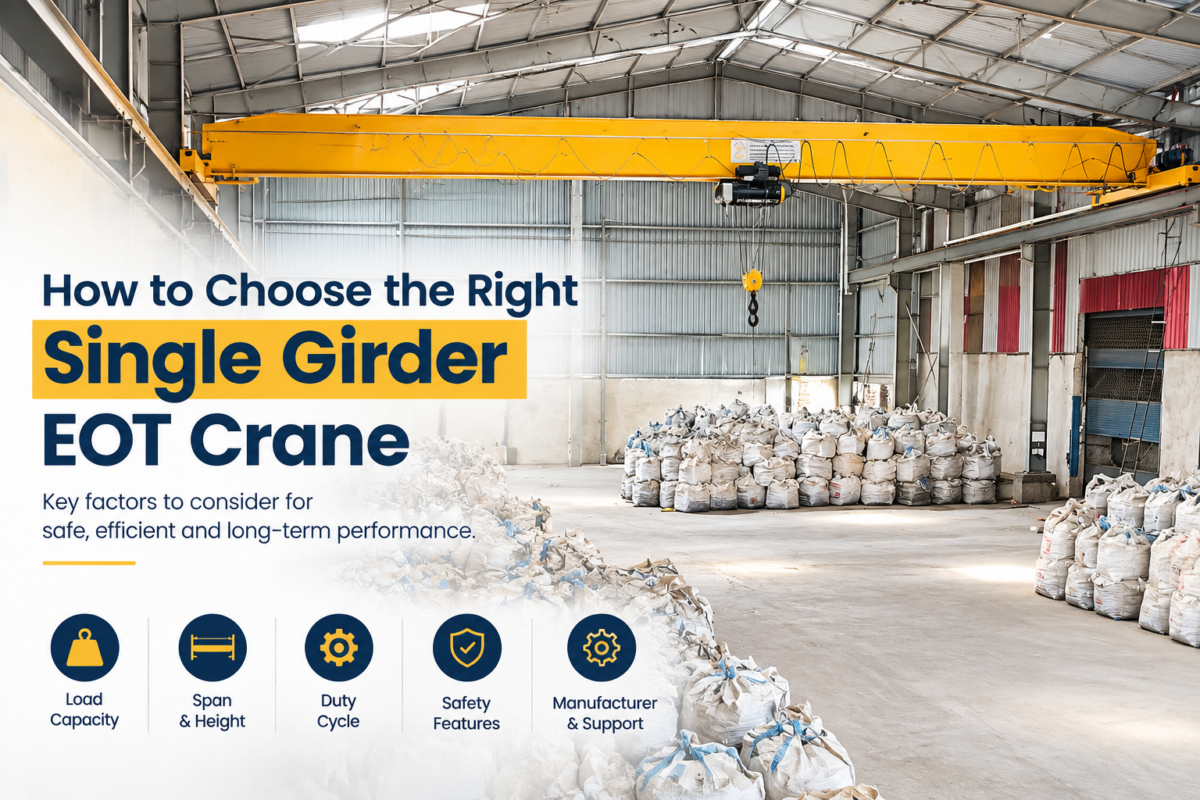
Choosing the right crane for an industrial facility is not simply about selecting a lifting capacity. A crane needs to match the way your team works, the available space, the type of material being handled, and the working conditions of the facility. Choosing the wrong configuration can affect productivity, maintenance requirements, and long-term operating costs.
A single girder EOT crane can be an efficient solution for many manufacturing units, workshops, warehouses, fabrication facilities, and material-handling applications. However, the right crane should be selected based on actual operating requirements rather than choosing a model only because it has a suitable load capacity.
This guide explains the important factors to consider when selecting a single girder EOT crane and what you should discuss with a crane manufacturer company before placing an order.
Understand Your Lifting Requirements
The first step is to clearly define what the crane will be expected to lift.
Start by considering the maximum load weight that will be handled during regular operations. Do not base your selection only on the average load. If heavier loads are occasionally lifted, those requirements should also be considered.
Important points include:
- Maximum lifting capacity
- Typical working load
- Frequency of lifting operations
- Type and dimensions of the load
- Required lifting speed
- Required travelling speed
- Number of lifting cycles per day
For example, a crane used occasionally for moving fabricated components may have very different requirements from one operating continuously in a busy production facility.
Choose the Right Single Girder EOT Crane
Select the Correct Crane Capacity
Crane capacity is one of the most important selection criteria. The rated capacity should be sufficient for the heaviest load that the crane is designed to handle.
Avoid selecting a crane with a significantly higher capacity than necessary simply for additional safety margin. Oversizing can increase the initial investment as well as structural and operational requirements.
At the same time, selecting a crane with insufficient capacity can create serious operational and safety concerns.
A professional assessment should consider the actual load requirements, lifting accessories, duty cycle, and future requirements before finalizing the capacity.
Consider the Required Span
The span refers to the distance between the crane runway rails. Your building dimensions and the working area will determine the span required for the crane.
Before finalizing the design, evaluate:
- Building width
- Runway arrangement
- Available clearance
- Column positions
- Obstructions inside the facility
- Required hook coverage
The crane should provide sufficient coverage of the working area without unnecessarily extending the design beyond what is required.
Accurate measurements of the building are therefore important before the crane design is finalized.
Check the Required Lifting Height
Lifting height determines how high the hook needs to travel to perform the intended operation.
Consider the height of:
- Trucks and loading areas
- Production machinery
- Storage racks
- Fabricated structures
- Work platforms
- Material stacking areas
You should also consider the available headroom between the building roof, crane components, and the maximum required hook position.
A properly planned crane allows materials to be lifted and moved efficiently without creating unnecessary clearance problems.
Evaluate the Duty Class
Not every crane operates under the same workload. A crane working for a few lifting cycles each day has different requirements from one operating continuously over multiple shifts.
The duty classification should be selected according to:
- Working hours per day
- Number of lifting cycles
- Average load
- Maximum load
- Frequency of operation
- Operating environment
Discuss your actual operating pattern with the manufacturer rather than selecting a duty class based only on the crane’s lifting capacity.
This can help ensure that the crane’s components are appropriately selected for the expected workload.
Think About the Operating Environment
The environment where the crane will operate can influence its design and components.
For a standard indoor workshop, conventional configurations may be sufficient. However, special consideration may be necessary for facilities exposed to:
- Dust
- High temperatures
- Moisture
- Chemicals
- Outdoor conditions
- Corrosive atmospheres
- Explosive or hazardous environments
If the crane will be used in a specialized environment, communicate these conditions clearly before ordering. The electrical components, protection levels, materials, and other specifications may need to be selected accordingly.
Choose the Right Hoist Configuration
The hoist is responsible for lifting and lowering the load, so its specifications should match the application.
Depending on your requirements, you may need to evaluate:
- Lifting speed
- Hoist type
- Hook arrangement
- Motor specifications
- Control system
- Lifting height
- Load handling requirements
A crane used for precise positioning may benefit from suitable speed control, while a high-throughput application may place greater emphasis on efficient lifting and travelling operations.
Consider Travel and Lifting Speeds
Speed can have a direct effect on productivity. However, faster is not always better.
The appropriate speed depends on how materials are moved within the facility. High speeds may be useful for applications involving frequent transportation across larger areas, while slower and controlled movement may be more appropriate for precision handling.
Consider the complete movement cycle rather than focusing on only one speed specification.
Evaluate Control Options
Modern EOT cranes can be operated through different control arrangements depending on the application.
Common considerations include:
- Pendant control
- Remote control
- Cabin operation
- Variable speed control
- Emergency stop systems
- Limit switches
- Overload protection
The control system should make operation convenient while allowing the operator to maintain good visibility of the load and surrounding area.
Consider the Building Structure
An EOT crane works together with the runway system and supporting structure of the facility. Therefore, the building should be evaluated before installation.
Important structural considerations include:
- Runway beam arrangement
- Column spacing
- Building height
- Roof structure
- Wheel loads
- Available clearances
- Existing structural limitations
If the crane is being installed in an existing facility, a structural assessment can help identify limitations before manufacturing begins.
Compare Quality Instead of Only Price
Price is naturally an important factor when purchasing industrial equipment, but it should not be the only deciding factor.
A lower initial price may not necessarily result in lower overall costs. Consider the expected service life, component quality, maintenance requirements, availability of spare parts, after-sales support, and overall reliability.
When comparing a single girder EOT crane manufacturer, look beyond the quotation and examine the technical specifications being offered.
Ask questions such as:
- What components are being used?
- What is the expected service life?
- Is customization available?
- What testing is carried out?
- What warranty is provided?
- Is installation support available?
- Are spare parts readily available?
- What maintenance support is offered?
Choose an Experienced Manufacturer
Selecting an experienced single girder EOT crane manufacturer in India can make the procurement process easier, particularly when the application requires customized dimensions or operating specifications.
A capable manufacturer should be able to understand your lifting requirements and recommend a configuration based on your actual working conditions.
Look for experience in designing cranes for applications similar to yours and check whether the manufacturer can provide technical documentation, installation support, testing, and after-sales assistance.
Work With the Right Supplier
The role of a single girder EOT crane supplier is not limited to delivering the equipment. Good technical communication before and after installation can make a significant difference.
A reliable supplier should be able to help with:
- Product selection
- Technical specifications
- Site requirements
- Installation coordination
- Commissioning
- Operator guidance
- Maintenance support
- Spare parts
Clear communication also reduces the possibility of selecting specifications that do not match the actual application.
Safety Features Should Be a Priority
Safety should always be considered alongside performance and cost.
Depending on the crane design and application, important safety provisions may include:
- Overload protection
- Emergency stop controls
- Limit switches
- Braking systems
- Appropriate electrical protection
- Reliable control systems
- Properly designed hooks and lifting components
The crane should be operated and maintained according to the manufacturer’s instructions and applicable safety requirements.
Consider Maintenance and Spare Parts
Even a well-designed crane requires regular inspection and maintenance. Before purchasing, understand what maintenance will be required and how easily critical components can be serviced or replaced.
Ask about the availability of:
- Motors
- Brakes
- Gearboxes
- Wheels
- Electrical components
- Hoist components
- Control equipment
- Lifting accessories
Easy access to replacement parts and technical support can help reduce downtime over the crane’s operating life.
Why Customization Can Matter
Industrial facilities rarely have identical layouts or operating requirements. A standard crane may work well in one facility but require modifications for another.
Customization may involve factors such as:
- Crane span
- Lifting height
- Capacity
- Travel speed
- Hoist speed
- Control method
- Building clearance
- Special environmental requirements
Ambica Engineering focuses on understanding application requirements so that crane configurations can be aligned with the operational needs of different industrial facilities.
Questions to Ask Before Buying
Before finalizing your crane, make sure you have answers to these questions:
- What is the maximum load the crane needs to lift?
- What lifting height is required?
- What span is suitable for the building?
- How frequently will the crane operate?
- What duty classification is appropriate?
- What type of loads will be handled?
- What lifting and travelling speeds are required?
- What control system is most suitable?
- Are there environmental conditions that require special components?
- What installation and maintenance support is available?
- How easily can spare parts be obtained?
- What safety features are included?
Answering these questions before placing an order can make the selection process much clearer.
Conclusion
Choosing the right single girder EOT crane requires more than comparing lifting capacities and prices. The best choice is one that fits your load requirements, span, lifting height, duty cycle, operating environment, building structure, speed requirements, and long-term maintenance needs.
Take time to understand your application and discuss the technical requirements with an experienced manufacturer or supplier. A properly selected crane can provide dependable material handling, improve workflow, and deliver value throughout its operating life.
For industrial businesses looking for a suitable lifting solution, working with an experienced single girder EOT crane manufacturer such as Ambica Engineering can help simplify the selection process and ensure the crane is designed around the application’s practical requirements.