
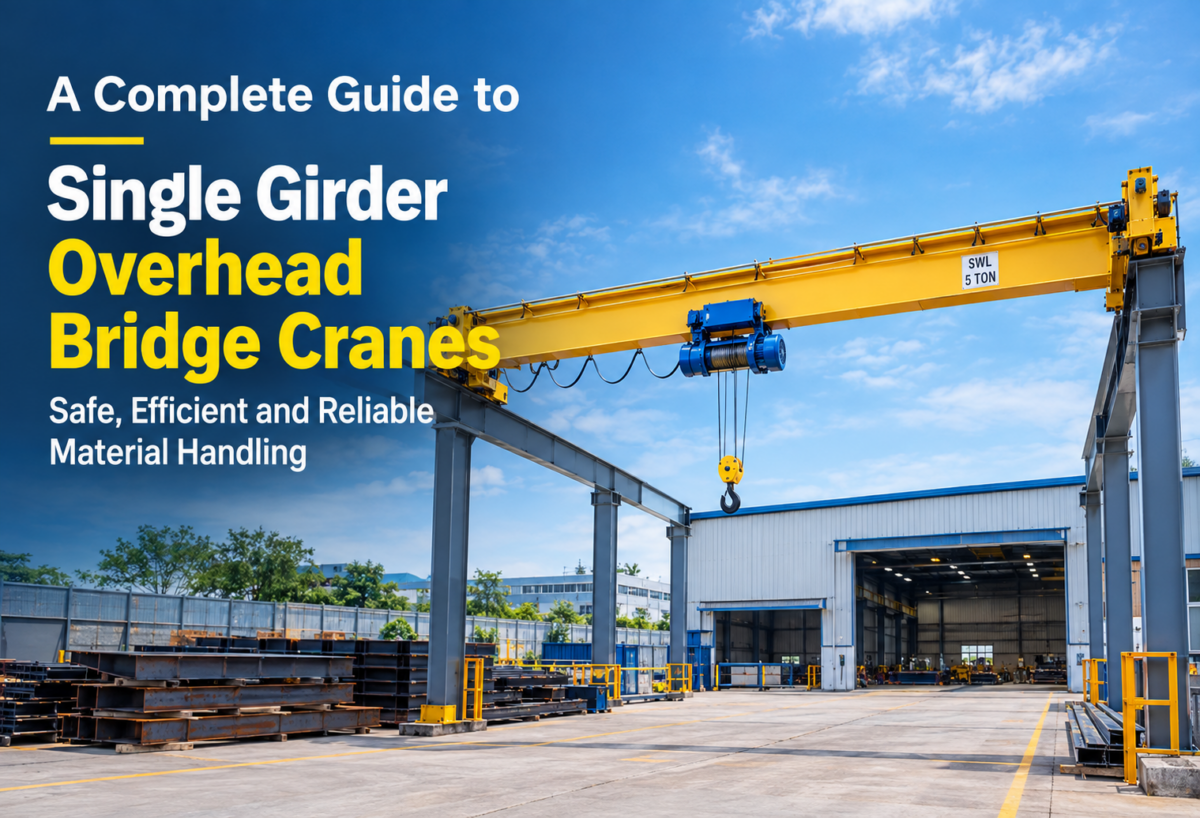
Moving heavy materials safely and efficiently is an important part of many industrial operations. From manufacturing units and workshops to warehouses and fabrication facilities, lifting equipment helps reduce manual handling and keeps production moving smoothly.
Among the different types of overhead lifting equipment, single girder overhead bridge cranes are widely used because they offer a practical combination of lifting capacity, compact design, and cost efficiency. They are suitable for applications where moderate loads need to be moved across a defined working area.
This guide explains how single girder overhead bridge cranes work, their main components, benefits, applications, and factors to consider before choosing one.
What Is a Single Girder Overhead Bridge Crane?
A single girder overhead bridge crane is a type of overhead crane that uses one horizontal bridge girder to support the hoist and trolley. The bridge travels along parallel runways installed at an elevated level, allowing materials to be lifted and moved horizontally within the workspace.
The hoist moves along the bridge girder, while the bridge itself travels along the runway. This combination provides movement in multiple directions and allows operators to position loads accurately.
Compared with double girder cranes, single girder systems generally have a simpler construction and are often selected for light to medium-duty lifting applications.
How Does a Single Girder EOT Crane Work?
An electric overhead travelling crane operates through coordinated movement between the bridge, trolley, and hoist.
The basic working process is straightforward:
- The hoist lifts the load using a wire rope or lifting mechanism.
- The trolley moves the hoist along the bridge girder.
- The bridge travels along the runway to move the load across the facility.
- The operator controls the lifting and travelling movements to place the material at the required location.
Depending on the application, cranes can be operated through pendant controls, radio remote controls, or a cabin.
Main Components of a Single Girder Overhead Crane
Understanding the major components can help businesses select and maintain the right crane for their requirements.
Bridge Girder
The bridge girder is the main horizontal structural member of the crane. It supports the trolley and hoisting equipment while travelling across the runway.
Hoist
The hoist performs the primary lifting function. It raises and lowers materials using an electric motor and lifting mechanism.
Trolley
The trolley carries the hoist and moves it across the bridge girder. This movement helps position loads accurately within the working area.
End Carriages
End carriages are attached to the ends of the bridge girder. They contain wheels and drive mechanisms that allow the crane bridge to travel along the runway.
Runway System
The runway consists of rails or beams along which the crane travels. Proper runway alignment is essential for smooth and reliable operation.
Electrical and Control System
The electrical system supplies power to the crane’s motors and controls. Depending on the crane design, operators may use pendant stations, remote controls, or other control systems.
Benefits of Single Girder Overhead Bridge Cranes
Single girder cranes can provide several practical advantages for industrial facilities.
Cost-Effective Design
Their relatively simple structural design can make them a cost-effective option for facilities that do not require the higher capacities associated with heavy-duty double girder cranes.
Efficient Use of Space
The compact design can be useful where available headroom and floor space are limited. A properly designed system can provide effective lifting without taking up unnecessary working space.
Suitable for Moderate Loads
These cranes are commonly used for light to medium lifting requirements. They can handle materials such as machinery components, fabricated parts, raw materials, and finished products.
Easier Maintenance
With fewer major structural components than some heavier crane systems, routine inspection and maintenance can be relatively straightforward when the crane is properly designed and installed.
Improved Material Handling
Instead of depending heavily on forklifts or manual handling, overhead cranes can move loads along a predetermined path. This can help organize production areas and reduce unnecessary movement of materials at floor level.
Flexible Applications
Single girder overhead cranes can be configured according to the building layout, lifting requirements, span, height, and operating conditions.
Where Are Single Girder EOT Cranes Used?
These cranes are suitable for a variety of industrial and commercial environments, including:
- Manufacturing plants
- Engineering workshops
- Fabrication units
- Warehouses
- Automobile component facilities
- Steel and metalworking industries
- Machinery manufacturing units
- Assembly areas
- Maintenance workshops
- Material handling facilities
The appropriate crane configuration depends on the weight and dimensions of the loads, lifting frequency, available headroom, span, runway length, and operating environment.
Single Girder vs. Double Girder EOT Crane
Both crane types are designed for overhead material handling, but their construction and typical applications differ.
A single girder crane uses one main bridge girder and is generally suitable for lighter or moderate lifting requirements. A double girder crane uses two bridge girders and is often selected for heavier loads, longer spans, higher lifting heights, or more demanding operating conditions.
The choice should not be based only on lifting capacity. Factors such as duty cycle, building structure, hook height, span, operating frequency, and future expansion should also be considered.
How to Choose the Right Single Girder Overhead Crane
Choosing the right crane requires more than simply selecting a lifting capacity. Consider the following factors before making a decision.
Determine the Required Capacity
Start by identifying the maximum load that the crane will need to lift. The crane should be selected according to the actual application rather than choosing an unnecessarily high capacity.
Check the Required Span
The span determines how much horizontal distance the crane must cover. Accurate measurements of the building and runway area are important during planning.
Consider Lifting Height
The required hook height depends on the size of the loads and the available vertical space inside the facility.
Evaluate Duty Cycle
How frequently the crane will operate is another important consideration. A crane used continuously in production may require a different configuration from one used occasionally for maintenance work.
Consider Operating Environment
Temperature, dust, humidity, corrosive substances, outdoor exposure, and other environmental conditions can influence the crane design and component selection.
Review Safety Features
Safety should remain a key consideration when selecting lifting equipment. Consider braking systems, overload protection, limit switches, emergency controls, and appropriate electrical protection based on the application and applicable requirements.
Why Work With an Experienced Crane Manufacturer?
An overhead crane’s performance depends not only on the equipment itself but also on proper design, manufacturing, installation, and after-sales support.
An experienced single girder EOT crane manufacturer in India can assess the lifting requirements, working environment, building dimensions, and operating conditions before recommending a suitable configuration.
A reliable manufacturer should also be able to provide technical support, installation assistance, inspection guidance, spare parts, and maintenance services throughout the crane’s working life.
Ambica Engineering provides industrial crane solutions designed around different material-handling requirements, helping businesses select equipment according to their operational needs.
Choosing a Single Girder EOT Crane Supplier
When comparing a single girder EOT crane supplier, look beyond the initial equipment price. Consider the manufacturer’s experience, product quality, customization capabilities, technical support, installation services, and availability of spare parts.
A supplier that understands your application can help avoid problems caused by selecting a crane that is either unsuitable for the workload or unnecessarily oversized.
It is also useful to discuss future requirements. If your production capacity is expected to increase, planning for possible changes during the initial crane design can save time and expense later.
Maintenance Tips for Single Girder Overhead Cranes
Regular maintenance helps keep the crane reliable and reduces the risk of unexpected downtime.
Some important practices include:
- Inspect wire ropes, hooks, brakes, and lifting components regularly.
- Check electrical connections and control systems.
- Monitor unusual sounds, vibration, or movement during operation.
- Inspect wheels, rails, and end-carriage components.
- Lubricate components according to the manufacturer’s recommendations.
- Check safety devices and limit switches.
- Maintain proper records of inspections and repairs.
- Address abnormal performance before continuing regular operation.
Maintenance schedules should be based on the crane’s operating conditions, usage, manufacturer’s recommendations, and applicable safety requirements.
Safety Considerations
Overhead cranes handle heavy loads, so safe operation is essential. Operators should be properly trained and should understand the crane’s controls, rated capacity, load-handling procedures, and workplace safety requirements.
Loads should be securely attached before lifting, and people should remain clear of suspended loads. Routine inspections and timely maintenance are equally important for safe operation.
Conclusion
Single girder overhead bridge cranes are a practical solution for many industries that need dependable overhead material handling. Their relatively compact design, efficient operation, and suitability for moderate lifting requirements make them useful in manufacturing plants, workshops, warehouses, and other industrial facilities.
The right crane depends on several factors, including load capacity, span, lifting height, duty cycle, operating environment, and available space. Working with an experienced single girder EOT crane manufacturer can help ensure that the equipment is designed around the actual requirements of your facility.
With proper selection, installation, operation, and maintenance, a single girder overhead crane can become an important part of an efficient and organized material-handling system.