
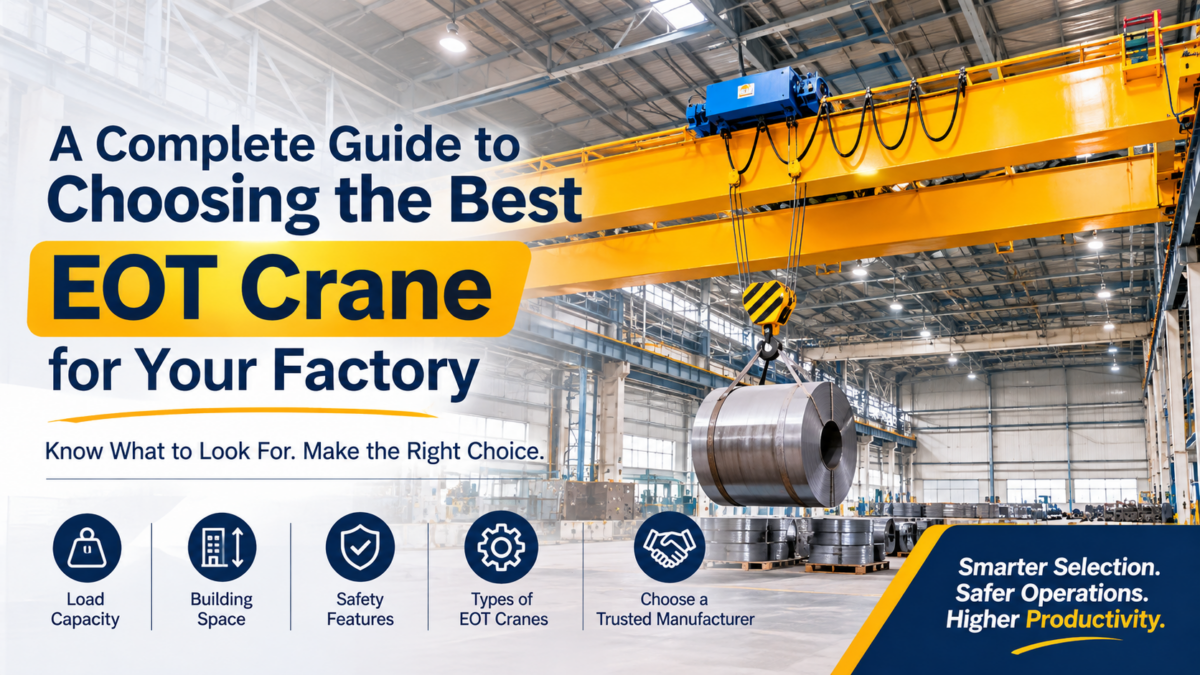
A Complete Guide to Choosing the Best EOT Crane for Your Factory
Choosing the right crane is an important decision for any factory that regularly moves heavy materials, machinery, raw materials, or finished products. The right equipment can improve productivity, reduce manual handling, make better use of available space, and support safer working conditions.
An Electric Overhead Travelling (EOT) crane is widely used in manufacturing plants, engineering workshops, warehouses, steel industries, and other industrial facilities. However, not every crane is suitable for every application. Factors such as load capacity, building layout, lifting height, operating frequency, and available budget should be considered before making a decision.
If you are comparing options from an EOT crane manufacturer, this guide will help you understand the main crane types, important selection criteria, safety requirements, and long-term maintenance considerations.
What Is an EOT Crane?
An Electric Overhead Travelling crane is a material-handling system that moves loads horizontally and vertically within a designated working area. It generally consists of a bridge structure, end carriages, an electric hoist or trolley, motors, controls, and lifting accessories.
The crane travels along overhead runway rails, allowing operators to move materials between different workstations without occupying valuable floor space.
EOT cranes are commonly used for:
- Moving raw materials and finished products across production areas.
- Lifting heavy machinery and industrial components.
- Handling steel plates, metal sections, and fabricated structures.
- Supporting assembly lines and manufacturing processes.
- Loading and unloading materials in workshops and industrial facilities.
By reducing dependence on manual material handling, an appropriately selected crane can help factories improve workflow and operational efficiency.
Types of EOT Cranes Used in Factories
Understanding the available crane configurations is the first step toward choosing equipment that matches your operational requirements.
1. Single Girder EOT Crane
A single girder EOT crane uses one main bridge girder, with the hoist typically travelling along the girder. It is often suitable for light to medium-duty lifting applications, depending on the design and rated capacity.
Key advantages:
- Generally requires less structural material than a comparable double girder design.
- Can be a practical option for workshops with limited headroom.
- Offers an efficient solution for routine material movement.
- May require a lower initial investment for suitable applications.
Single girder cranes are commonly considered for small and medium-sized manufacturing units, fabrication workshops, assembly areas, and maintenance facilities.
2. Double Girder EOT Crane
A double girder EOT crane uses two main bridge girders to support the hoist or trolley arrangement. It is frequently selected for heavier loads, demanding operating conditions, and applications requiring greater lifting heights or specialized lifting arrangements.
Key advantages:
- Suitable for many heavy-duty material-handling applications.
- Can accommodate specialized hoists and lifting attachments.
- May provide greater lifting height with an appropriate trolley configuration.
- Can be designed for demanding industrial operating cycles.
These cranes are often used in steel plants, heavy engineering facilities, foundries, large manufacturing units, and other industries where load requirements justify the configuration.
3. Customized and Turnkey EOT Crane Systems
Some factories need more than a standard crane. Their buildings, production lines, load dimensions, or handling processes may require a customized solution.
A Turnkey EOT Crane project generally involves coordinating multiple stages of the installation, which may include requirement assessment, engineering, manufacturing, supply, installation, testing, and commissioning. The exact scope depends on the supplier’s agreement with the customer.
A turnkey approach can simplify project coordination by providing a defined point of responsibility for the agreed scope of work. Before proceeding, confirm whether civil and structural modifications, runway beams, electrical connections, operator training, and maintenance support are included.
Important Factors to Consider When Choosing an EOT Crane
Determine the Required Load Capacity
Load capacity is one of the most important factors when selecting an overhead crane. Start by identifying the heaviest load the crane will lift during normal operations.
Consider the weight of the material, lifting attachments, and any other loads accounted for in the crane’s rated configuration. Do not select a crane based only on the average weight of the materials handled.
The rated capacity must be established in accordance with the applicable design and safety requirements. Avoid overloading a crane, as doing so can damage components and create serious safety risks.
Check the Available Building Space
The factory’s physical layout directly affects crane design. Before selecting a model, measure the building span, runway length, available headroom, roof clearance, and the height of the highest load that must be lifted.
Also consider columns, machinery, lighting systems, ventilation equipment, and other obstructions.
A site assessment can help determine whether a single girder, double girder, or customized arrangement is appropriate. It can also identify whether structural modifications are necessary before installation.
Understand the Required Lifting Height
Lifting height refers to the vertical distance through which the crane must raise a load. The required height depends on the dimensions of the materials, storage arrangements, machinery, and the clearance needed during movement.
Check the distance between the floor and the highest lifting point, along with the space available between the roof and the crane structure.
Selecting the right hoist and trolley arrangement can help make effective use of the available headroom.
Evaluate Duty Cycle and Operating Frequency
A crane used occasionally for maintenance may have very different requirements from one operating continuously throughout a production shift.
Evaluate how frequently the crane will operate, how many lifting cycles it will perform, the typical load spectrum, and the expected operating environment.
These details help engineers determine the appropriate duty classification, motor specifications, braking system, and mechanical components.
Explain your actual working conditions to the manufacturer instead of choosing a crane based solely on its rated lifting capacity.
Consider the Type of Material Being Handled
Different materials require different lifting arrangements. Steel coils, long metal sections, machinery, containers, and fabricated components may need specialized lifting accessories.
Depending on the application, the crane may use hooks, grabs, lifting beams, magnets, or other approved attachments.
The attachment must be suitable for the load, and its weight and configuration must be considered in the overall lifting design. Discuss the dimensions, shape, centre of gravity, and handling method of your materials before finalizing the equipment.
Review Safety Features and Control Systems
Safety should be a priority when comparing crane options. Depending on the application and applicable requirements, important features may include:
- Overload protection.
- Emergency stop controls.
- Limit switches for lifting and travel movements.
- Reliable brakes and appropriate braking arrangements.
- Audible or visual warning devices where required.
- Pendant or radio remote controls with suitable operating safeguards.
- Safe access for inspection and maintenance.
Confirm which safety features are included in the proposed design and which are optional. Operators should also receive appropriate training, and the crane should be inspected and maintained according to its instructions and applicable regulations.
Compare Total Cost, Not Just Purchase Price
The initial purchase price is only one part of the overall cost of owning an EOT crane.
Consider the costs of installation, supporting structures, electrical work, commissioning, operator training, routine maintenance, spare parts, and potential downtime.
A lower-priced crane may not be the most economical option if it does not suit the factory’s operating requirements. Compare technical specifications, component quality, warranty terms, service availability, and expected maintenance needs before making your decision.
Assess After-Sales Support and Spare Parts Availability
Reliable service support is important for keeping a crane operational over the long term. Before selecting a supplier, ask about installation assistance, inspection support, troubleshooting, replacement components, and maintenance services.
Check whether commonly required spare parts are readily available and whether the supplier can provide technical documentation and operating instructions.
A dependable service arrangement can help reduce avoidable downtime and make long-term maintenance easier to manage.
How to Choose the Right EOT Crane Manufacturer
Finding a suitable EOT crane manufacturer in India involves more than comparing quotations. The manufacturer should understand your application and be able to recommend a crane configuration based on the factory’s actual requirements.
Consider the following points when evaluating potential manufacturers:
- Technical expertise: Look for a company that can explain crane configurations, load capacity, duty requirements, lifting height, and structural considerations clearly.
- Customization capabilities: Confirm whether the manufacturer can adapt the crane design to your building layout, material dimensions, and operating conditions.
- Manufacturing quality: Ask about quality-control procedures, component specifications, inspection records, and relevant conformity documentation.
- Installation and commissioning: Understand who is responsible for installation, testing, commissioning, and handover.
- Service and maintenance: Evaluate the availability of technical support, spare parts, and maintenance assistance after installation.
- Transparent quotations: Ensure the quotation clearly defines the crane specifications, included equipment, exclusions, warranty, delivery schedule, and service responsibilities.
A professional supplier should be willing to understand your requirements before recommending a solution.
Finding an EOT Crane Manufacturer in Ahmedabad
For factories located in Gujarat, working with an EOT crane manufacturer in Ahmedabad may make communication, site visits, project coordination, and service arrangements more convenient.
Ahmedabad and its surrounding industrial areas have manufacturing and engineering businesses with a range of material-handling requirements. When evaluating a local manufacturer, focus on technical capability and service quality rather than location alone.
Ask the manufacturer to assess your site, review your lifting requirements, and provide a detailed technical proposal. If your factory is outside Ahmedabad, confirm service coverage, installation arrangements, and response times for maintenance support.
The most suitable manufacturer is one that can deliver a crane aligned with your operational needs, safety requirements, and long-term plans.
Why Consider an EOT Crane Supplier in India?
An experienced EOT crane supplier in India can help coordinate the equipment selection and supply process according to your project’s requirements. Depending on the supplier’s capabilities, support may include technical consultation, crane manufacturing, electrical systems, installation coordination, and after-sales service.
Before placing an order, request a detailed quotation that specifies:
- Rated lifting capacity and lifting height.
- Crane span and runway travel length.
- Single girder or double girder configuration.
- Hoist, trolley, motors, and control systems.
- Electrical requirements and operating controls.
- Safety devices and applicable design standards.
- Installation, commissioning, warranty, and maintenance scope.
Reviewing these details helps you compare quotations on a like-for-like basis and reduces the risk of unexpected costs during installation.
Benefits of a Turnkey EOT Crane Solution
A turnkey crane project may be useful for factories that prefer coordinated delivery of multiple project stages rather than managing separate contractors for every activity.
Depending on the agreed scope, a Turnkey EOT Crane solution may offer the following benefits:
- Coordinated project planning: Engineering, equipment supply, and installation activities can be planned around the factory’s requirements.
- Simplified communication: Having a clearly defined project coordinator can make it easier to manage technical questions and project updates.
- Application-specific design: The crane can be planned around the building layout, material flow, lifting requirements, and production process.
- Clearer project responsibilities: A written scope of work helps identify who is responsible for each stage of the project.
- Organized commissioning: Testing, documentation, and handover can be coordinated before the equipment enters regular service.
However, turnkey does not automatically mean that every civil, electrical, or structural activity is included. Confirm the scope, responsibilities, delivery milestones, and acceptance criteria in writing before starting the project.
Common Mistakes to Avoid When Buying an EOT Crane
Even a well-planned purchase can lead to operational difficulties if important requirements are overlooked. Avoid these common mistakes:
- Selecting the crane based only on the maximum load without reviewing duty requirements.
- Ignoring available headroom and building clearances.
- Choosing equipment without considering future production needs.
- Overlooking the weight and suitability of lifting attachments.
- Comparing quotations without checking the complete technical specifications.
- Ignoring operator training, inspection, and preventive maintenance.
- Failing to clarify installation responsibilities and warranty coverage.
Taking time to review these factors before purchasing can help prevent costly modifications and unnecessary downtime later.
EOT Crane Maintenance for Long-Term Performance
Regular maintenance helps maintain safe operation and identify potential problems before they lead to major failures. A preventive maintenance plan should follow the manufacturer’s recommendations, the crane’s duty classification, and applicable safety requirements.
Typical maintenance activities include:
- Inspecting wire ropes, chains, hooks, and lifting attachments.
- Checking brakes, motors, gearboxes, and travel mechanisms.
- Examining electrical connections, controls, and limit switches.
- Monitoring unusual noise, vibration, overheating, or movement.
- Inspecting structural components and runway systems.
- Maintaining records of inspections, repairs, and servicing.
The inspection frequency should reflect operating conditions and the applicable requirements. Defects that affect safe operation should be addressed before the crane returns to service.
Conclusion
Choosing the best EOT crane for your factory requires a clear understanding of load capacity, lifting height, building dimensions, duty cycle, material type, safety features, and long-term operating costs. A single girder crane may suit many routine material-handling tasks, while a double girder or customized system may be more appropriate for heavier or specialized applications.
When comparing an EOT crane manufacturer, EOT crane supplier in India, or a turnkey project provider, evaluate technical expertise, manufacturing quality, installation support, warranty terms, and after-sales service alongside the purchase price.
By assessing your requirements carefully and obtaining a detailed technical proposal, you can select a crane that supports efficient material movement, reliable operation, and the long-term needs of your factory.